
The New Benchmark in Revenue Assurance: RASSURE vs. Traditional Audits
Published on October 7, 2026 • By Admin
The New Benchmark in Revenue Assurance: RASSURE vs. Traditional Audits
For decades, airline revenue assurance ran on the same playbook: sample a slice of tickets, apply manual rules, wait months for a report, and hope the leakage you caught was bigger than the leakage you missed. That playbook isn’t broken because auditors got lazy, it’s broken because it was never built for the volume and speed of how airlines sell tickets today.
Over the past decade, RASSURE has worked with 10+ global airlines, across 5 continents. Recently we ran a multi-client benchmark study comparing our revenue audits against legacy BPO and manual setups. The question we wanted to answer: what happens when you replace sampling with 100% coverage, 500+ check per ticket and simply add a layer of PNR-GDS-ATPCO cross-checks for a full journey view in the audit?
The answer: airlines recover more, recover it faster, and spend far less effort optimizing their financial controls and operational procedures. Here’s the evidence…
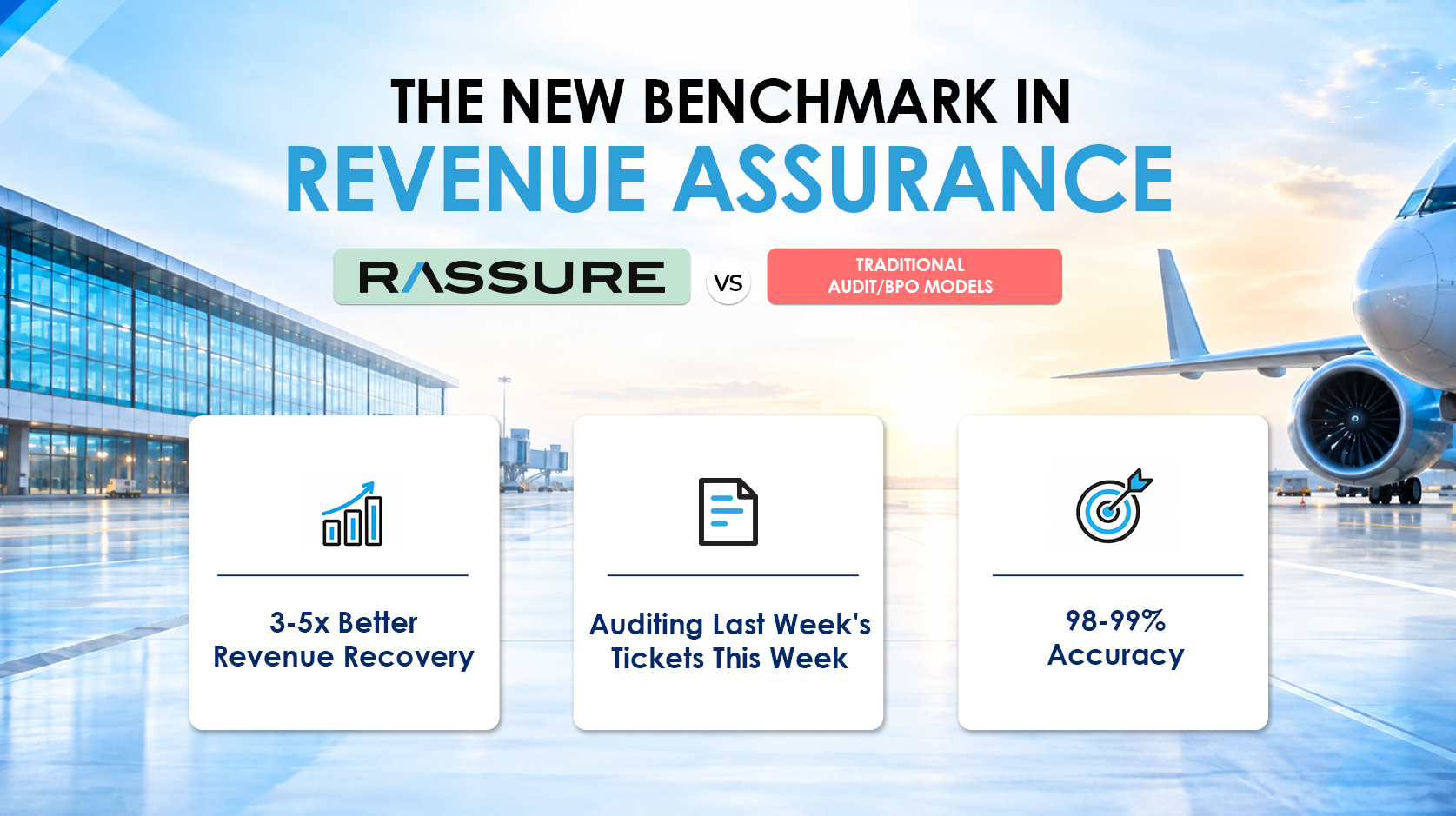
RASSURE audits are BETTER: We recover revenue that traditional audits never find
A global Middle Eastern carrier recovered 5.2x more revenue after switching from its legacy audit setup to RASSURE’s full-scope automated audits. In another example, a Southern European airline saw a 4x uplift in recovery, with RASSURE using the exact same dataset a traditional BPO auditor had already worked through. Same tickets, same violations sitting there the whole time, just never found.
The gap widens further with first-pass results. One Middle Eastern airline was recovering an average of $12,000 a month through its BPO audit. After switching to RASSURE’s first-pass audit on the same sales, that became $900,000 a month, peaking at $1.2 million. Results held steady month after month, with ADM rejection rates staying below 1%, a level of consistency that makes a second audit pass almost redundant.
Why did RASSURE perform better?
The difference comes down to four things traditional audits don’t do: checking 100% of tickets instead of a sample, auditing full-journey lifecycle using different datasets (PNR-GDS-ATPCO cross-checks), including auto-priced violations most audits assume don’t exist, running 500+ automated checks per ticket, and holding that performance steady across markets and airline types.
RASSURE audits are FASTER: Recovery that beats the backlog
Finding a leakage months after it happened is barely better than not finding it. By the time a traditional report lands, agents have moved on and records have gone cold.
Traditional BPO providers commonly run 3 to 4 months behind. RASSURE’s audits can deliver output in as little as a week. One Middle Eastern carrier reached the point where tickets issued in the last week could be fully audited by next week, down from a 3–4 month backlog it had lived with previously.
This matters for two industry specific reasons. First, IATA’s ADM validity window is 9 months for ADMs through BSP under Resolution 850m – A report that lands four months late leaves an airline racing a clock it shouldn’t have to race. Second, faster detection means cleaner disputes: when an ADM is raised while the transaction is still recent, agents can respond while details are fresh, leading to fewer rejections instead of both sides reconstructing events months later.
One airline in the study saw its IATA credit rating improve directly from a tighter audit-to-cash timeline, since IATA’s methodology accounts for how quickly ADMs are processed. Airlines can also choose their own cadence, weekly, fortnightly, or monthly to suit their audit needs.
RASSURE audits are EASIER: Less manual work, more confidence
This is where the case moves from headline numbers to daily operations. Traditional audits depend on constant human review to catch violations. In this approach a permanent overhead grows with every new check. This is one of the reasons they settle for dip-sampling audits.
A fully automated, full-lifecycle model flips that. After a one-time setup, the audit runs consistently on its own. And because it checks tickets across every system, not just whether the ticket looks correct in isolation, but whether it’s consistent across the GDS, the fare filing, the booking record, the flight and post-flight, it catches errors single-system audits structurally can’t see: GDS pricing discrepancies, ATPCO fare filing inconsistencies, and journey-level disruptions.
Another key finding of the study was that RASSURE consistently has high-ADM correctness with 98% to 99.9% range. For a revenue team, that means fewer manual escalations, fewer disputed ADMs, one onboarding process instead of an ever-growing rulebook, and more time for strategy instead of reconciliation.
The Bottom Line
Better, faster, and easier aren’t three separate pitches, they’re one outcome viewed from three angles. Checking 100% of tickets is what makes the recovery numbers bigger. Automating that checking end-to-end is what makes it fast enough to matter. And removing the dependency on manual rule maintenance is what makes it sustainable for a revenue team, month after month.
Today, the commercial aviation landscape is far more complex. Sales channels continue to expand, data is growing in volume and interconnectedness, and new sources of revenue leakage and recovery are emerging. Revenue assurance needs to evolve alongside this transformation. At RASSURE, we’re proud to support 10+ airlines in their transformation journey towards audit excellence. If you’re an airline looking to improve audit coverage, reduce revenue leakage, or explore advanced BIDT Audit or Sales Audit, we’d love to speak with you.